This systematic review aimed to evaluate the effects of rehabilitation exercise programs on dynamic balance in people more than 6 months post-stroke.
Recovery of balance and postural control after stroke is a major predictor of disability as it directly affects the patient’s achievement of independent daily living and quality of life. Common methods used in clinical settings to improve balance and postural control in stroke patients include strength training, isokinetic trunk training, trunk stabilization training, and task-oriented approaches. Dynamic balance training has been used to regain balance control however the effect of the type of exercise intervention applied to stroke patients’ balance and posture control is not yet clear. In particular, factors such as duration of intervention, type, and individual characteristics of patients lead to variation in effectiveness.
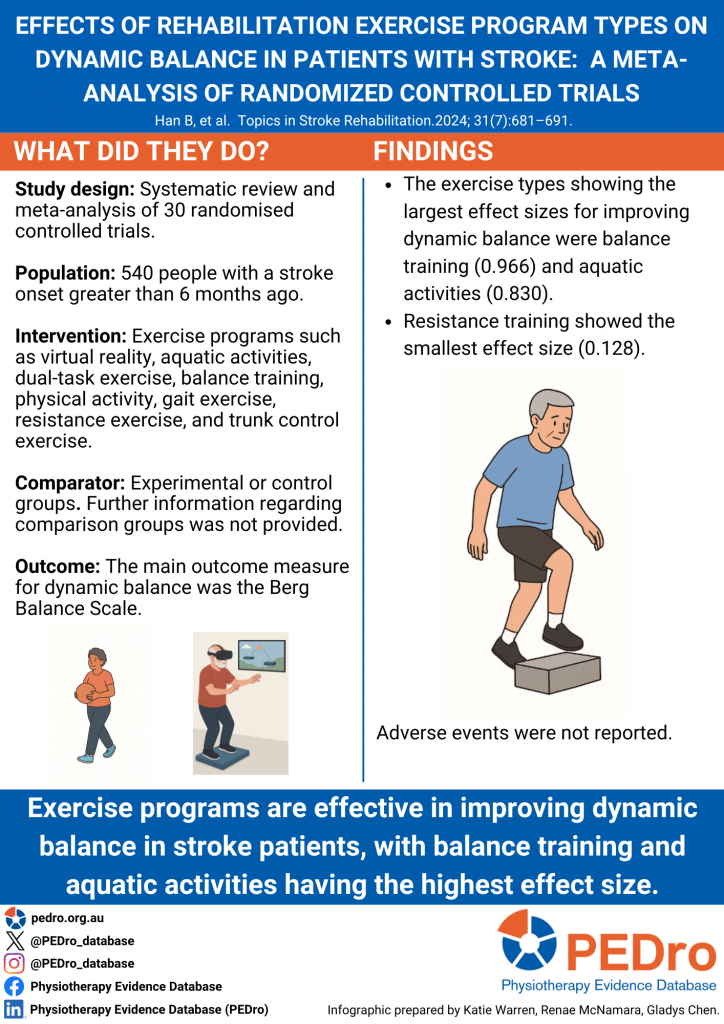
Three databases were searched (Medline, Web of Science, and ProQuest) for randomised controlled trials (RCTs) published between January 2018 and October 2022. Eligible studies included patients with a stroke onset greater than 6 months ago, intervention was exercise programs such as virtual reality, aquatic activities, dual-task exercise, balance training, physical activity, gait exercise, resistance exercise, and trunk control exercise on dynamic balance in stroke patients. Studies using robots, stimulation therapy and passive treatments were excluded. The outcome measure was limited to the Berg Balance Scale. The comparators were experimental and controlled groups.
The study selection process was conducted according to the Preferred Reporting Items for Systematic Reviews and Meta-Analysis (PRISMA) process with two researchers who searched, screened, and compared literature through keywords. Data analysis calculated the effect size (<0.2 small, 0.2-0.79 medium, ≥0.8 large). Publication bias was tested using a Forest Plot, Trim and Fill, and the quality of each study was evaluated through the diagnostic test of Comprehensive Meta-Analysis program ver.3 (CMA3) program.
Thirty trials with 540 participants were included. The mean age was 59.8 years old and stroke onset period was 27.1 months. Heterogeneity was assessed through the Cochrane’s Q and inconsistency test (I2), and a random effect model was used.
The overall effect of exercise for balance and postural control in stroke patients was medium (0.550 , 95% CI 0.331 to 0.769), according to the Cohen’s standard. No publication bias was detected, and the quality of the analysed papers was assessed as good.
Subgroup analyses were performed based on the level of heterogeneity for gender, age, period of onset, and types of exercise was calculated. Gender had a moderate effect size in males (0.551) and females (0.458). Exercise programs for balance were found to have the highest effect on stroke patients aged 60-64) when the time of stroke onset was greater than 50 months (1.060). However, the 95% CI for subgroup analyses and adverse events were not reported.
The subgroup analysis on exercise program type showed large effect sizes in balance training (0.966; 95% CI 0.552 to 1.380; 5 studies) and aquatic activities (0.830; 95% CI -0.251 to 1.912; 3 studies), moderate effect sizes in virtual reality (0.762; 95% CI 0.116 to 1.409; 3 studies), physical activity (0.581; 95% CI -0.657 to 1.819; 3 studies), gait training (0.541; 95% CI 0.130 to 0.951; 6 studies), dual-task (0.478; 95% CI 0.152 to 0.804; 3 studies), trunk control (0.284; 95% CI -0.092 to 0.659; 4 studies), and small effect sizes in resistance training (0.128; 95% CI -0.785 to 0.529; 3 studies). Balance training, dual-task, gait training, and virtual reality variables differed statistically significantly.
Exercise programs are effective in improving dynamic balance in stroke patients, with balance training having the highest effect size, particularly for when the time from onset of stroke is longer.
Han B, Lee J, Yim S, Kim D. Effects of rehabilitation exercise program types on dynamic balance in patients with stroke: a meta-analysis of randomized controlled trials. Topics in Stroke Rehabilitation 2024;31(7):681-691.