Coronary artery bypass grafting (CABG) is a common surgical treatment for many types of cardiovascular and coronary heart disease. However, people undergoing CABG surgery have a high-risk of developing post-operative pulmonary complications (PPCs). This systematic review aimed to synthesise and appraise the quality of evidence for the use of inspiratory muscle training (IMT), either pre- or post-operatively, for patients treated with CABG.
Five databases were searched for published studies with no language restrictions from inception to March 2023. Eligible studies were randomised controlled trials (RCTs) that used IMT to treat adult patients, >18 years of age, either prior to or following CABG surgery. The comparator was usual care, sham IMT or physiotherapy. Included trials reported at least one post-operative pulmonary complications (pneumonia, atelectasis, or pleural effusion).
The primary outcome was PPCs, measured by rates of pneumonia, atelectasis and pleural effusion. Secondary outcomes were respiratory function (including maximal inspiratory and expiratory pressures), hospital length of stay and exercise capacity. Adverse events were not assessed in the review. Study selection, data extraction and assessment of methodological quality, using the Cochrane Collaboration Risk of Bias tool (version 2), were performed by two authors independently. Evidence quality was assessed for the primary outcome only using the Grading of Recommendations, Assessment, Development, and Evaluation (GRADE) system. Meta-analyses using random effects models were used if statistical heterogeneity was >50%. Results were reported as relative risks (RR) or mean differences (MDs), with associated 95% confidence intervals (CIs). Subgroup analysis compared the effects of pre-operative and post-operative IMT on maximal inspiratory pressure (MIP).
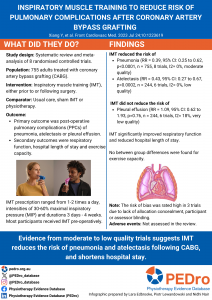
Eight trials with 755 participants (range 20-276) were included in the systematic review and meta-analysis. Trials compared IMT to usual care (5 trials), IMT to physiotherapy (2 trials) and IMT to sham IMT (1 trial). The intervention was delivered in the pre-operative period in four trials (n=621). Interventions varied with IMT being performed 1-2 times a day at an intensity of 30-60% maximal inspiratory pressure. Intervention duration ranged from 3 days to 4 weeks. Risk of bias was rated as ‘low’ in 2 trials, of ‘some concerns’ in 3 trials and ‘high’ in 3 trials. High risk of bias was attributable to lack of allocation concealment (2 trials); and lack of participant or assessor blinding (4 trials).
Compared to usual care, sham IMT or physiotherapy treatments, IMT reduced the risk of PPCs – pneumonia (RR = 0.39, 95% CI 0.25 to 0.62, p < 0.0001, n = 755, 8 trials, I2 = 0%, moderate quality evidence); and atelectasis (RR = 0.43, 95% CI 0.27 to 0.67, p=0.0002, n = 244, 6 trials, I2 = 0%, low quality evidence); but not pleural effusion (RR = 1.09, 95% CI 0.62 to 1.93, p=0.76, n = 244, 6 trials, I2 = 18%, very low quality evidence). No between group differences were found for exercise capacity, however the intervention group had significantly improved respiratory function and reduced hospital length of stay. Subgroup analysis showed preoperative IMT led to greater improvements in MIP than postoperative IMT (MD = 16.55 cmH₂O, 95% CI 13.86 to 19.24, p < 0.00001, n = 624, 4 trials vs. MD = 8.99 cmH₂O, 95% CI 2.39 to 15.60, p = 0.008, n = 114, 3 trials).
Evidence from moderate to low quality trials suggests IMT, compared to usual care, sham IMT or physiotherapy treatments, reduces the risk of pneumonia and atelectasis in patients following CABG, and shortens hospital stay.
Xiang Y, Zhao Q, Luo T, Zeng L. Inspiratory muscle training to reduce risk of pulmonary complications after coronary artery bypass grafting: a systematic review and meta-analysis. Front Cardiovasc Med. 2023 Jul 24;10:1223619. doi: 10.3389/fcvm.2023.1223619