
It has been proposed that dry cupping can improve musculoskeletal pain. The mechanisms are currently unknown and it is possible that treatment efficacy is as a result of the placebo effect. This systematic review aimed to estimate the efficacy of dry cupping compared to placebo cupping on pain intensity in people with musculoskeletal pain.
Seven databases were searched for randomised controlled trials (RCTs), there were no language restrictions. The eligibility criteria included people who were over 18 years and sought treatment for musculoskeletal pain in any area of the body for any length of time. Excluded trials were pain caused by specific pathology such as neurological or cardiac, or trials including participants within 12 months of a surgical intervention. The intervention was dry cupping. The comparator was placebo cupping which included treatments that mimicked dry cupping however did not create negative pressure.
The primary outcome was pain intensity which was measured through either the numerical rating scale or Visual Analogue Scale, converted to a 0-100 scale. Other outcomes included adverse events. Trials were included if they measured the outcomes up to 6 months post-intervention. Two authors independently screened and assessed each article with disagreements resolved by discussion or with consultation of a third review author. Risk of bias (ROB) was assessed by two authors using the Cochrane Risk of Bias 2.0 tool, with any disputes resolved through either discussion or a third author. Certainty of the evidence was assessed using the Grading of Recommendation, Assessment, Development and Evaluation (GRADE). A random effects meta-analysis for each timepoint was created.
There were 3330 articles identified after removal of duplicates and ineligible studies and screening for full texts. Five trials were included in the qualitative synthesis and four trials in the quantitative synthesis. There was a total of 281 participants split evenly between cupping and placebo groups.
The duration of the intervention ranged from 1 session of dry cupping to 8 sessions over 8 weeks. The duration of the sessions ranged from 8 minutes to 30 minutes and the number of cups used ranged from 1-17 cups. In all trials, the placebo cupping used cups with a hole in them to release the pressure. The ROB varied across the trials; ROB was low for one trial, unclear for one trial and high for three trials. Three out of five trials reported on adverse events – two trials reporting minor adverse events only and one trial reported minor and moderate adverse events.
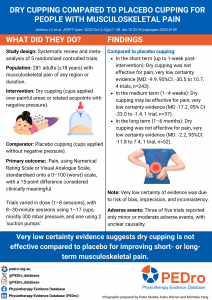
For pain in the short-term (immediately after intervention – 1-week post-intervention), there was very low certainty evidence that dry cupping was not different when compared to placebo cupping (MD -9.9, 95% CI -30.5 to 10.7, 4 trials, n=243). For pain in the medium term (1-4 weeks post-intervention), there was very low certainty evidence that dry cupping was effective, and the effect may be meaningful compared to placebo cupping (MD -17.2, 95% CI -33.0 to -1.4, 1 trial, n=37). For pain in the long term (4 weeks post intervention – 6 months post intervention), there was very low certainty evidence that dry cupping had no difference compared to placebo cupping (MD -2.2, 95% CI -11.8 to 7.4, 1 trial, n=52).
The evidence for cupping [GW1.1][PS1.2]compared to a placebo is very uncertain for treating musculoskeletal pain in the short, medium and long term.
Jenkins LC, et al. The efficacy of dry cupping compared to placebo cupping for people with musculoskeletal complaints: a systematic review with meta-analysis. JOSPT Open. 2025 Oct, Epub ahead of print. DOI: 10.2519/josptopen.2025.0159