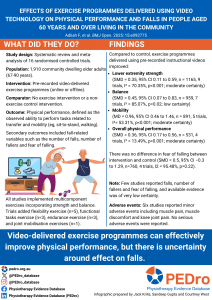
Systematic review found that video-delivered exercise programmes may improve physical performance, particularly lower extremity strength, balance and mobility in community-dwelling older adults aged ≥ 60 years, but there is uncertainty of its effect on fall rate, number of fallers and fear of falling. This systematic review and meta-analysis aimed to synthesise the evidence and evaluate the effect of exercise programmes delivered using instructional videos compared to no exercise or non-exercise control interventions on physical performance and falls in community-dwelling older adults aged ≥ 60 years.
Methods
Seven databases including MEDLINE, EMBASE, CINAHL, PsycINFO, the Cochrane Central Register of Controlled Trials, TRIP and PEDro were searched for randomised controlled trials (RCTs) published in English. The search also included grey literature to identify unpublished research material, accessed through Ethos and ProQuest. Full text articles were screened by two reviewers independently and disagreements resolved through discussion with a third reviewer. Eligible studies included community-dwelling older adults aged ≥ 60 years and trials utilising exercise programmes using pre-recorded instructional videos (online or offline) to demonstrate exercise compared to no exercise intervention or a non-exercise control intervention (e.g., leaflets, links to physical activity promotion websites or physical activity guidelines). Video-based exercises could be supplemented by home visits or in-person interactions with practitioners. The primary outcome was physical performance, assessed as a single measurement of overall physical performance as well as individual components including lower-extremity strength, balance, and mobility. Secondary outcomes were fall-related variables, including number of falls, number of fallers, and fear of falling. The reviewers contacted authors to obtain additional information on missing data. Risk of bias was evaluated by the first author using the Cochrane Risk of Bias Tool, and evidence quality was assessed using the Grading of Recommendations, Assessment, Development and Evaluation (GRADE) system. Both assessments were then reviewed and resolved through team discussion until consensus. Meta-analysis was conducted using a random-effects model due to heterogeneity of the population, measurements and interventions and only when at least three studies were available for comparison per outcome
Results – included trials
Sixteen trials, involving 1910 participants were included. The average age of participants ranged from 67 to 90 years, and all were older adults living in the community. One trial included only female participants, while fifteen included both males and females, though two had fewer female participants. All studies implemented multicomponent exercises incorporating strength and balance. Five trials added flexibility exercise, three added functional tasks exercise, three added endurance exercise, and one added joint mobilisation exercises. Ten trials delivered pre-recorded exercise videos offline using digital video discs (DVDs) or videotapes, while six used online delivery via smartphones, apps or websites. Eight trials compared video-delivered exercise to non-exercise interventions, while eight compared with no intervention.
Exercise programme frequency ranged from daily to five times per week; most commonly two to three times per week in eleven trials, daily in three trials, five times weekly in one, and not stated in one. The duration of intervention follow-up ranged from one month to two years; most commonly six months in five trials, one month in two trials, two months in one trial, three months in two trials, four months in two trials, five months in one trial, twelve months in two trials, and twenty-four months in one trial.
Of the included trials, three had low risk of bias, six raised some concerns, and seven had high risk of bias.
Meta-analysis showed that exercise programmes delivered using pre-recorded instructional videos improved lower extremity strength (SMD = 0.35, 95% CI 0.11 to 0.59, n = 1165, 9 trials, I² = 70.35%, p<0.001), balance (SMD = 0.45, 95% CI 0.07 to 0.83, n = 959, 7 trials, I² = 85.07%, p=0.02), mobility (MD = 0.96, 95% CI 0.46 to 1.46, n = 891, 5 trials I ²= 53.31%, p<0.001), and overall physical performance (SMD = 0.36, 95% CI 0.17 to 0.56, n = 531, 4 trials, I² = 13.49%, p<0.001) compared to control.
Results – outcome
Meta-analysis did not reveal a difference in fear of falling when comparing video-delivered exercise programmes to control. Only 3 studies reported on fall rate and number of fallers, which was insufficient for meta-analysis. Minor adverse events were reported in six studies, with no major adverse events.
Using the GRADE approach, the certainty of evidence was moderate for lower extremity strength, mobility, and overall physical performance, low for balance, and very low for fear of falling. The certainty of evidence was downgraded if greater than 25% of included trials had a high risk of bias, if there was statistical heterogeneity or wide CI and/or if there were less than 400 participants.
Conclusion
Low-to-moderate quality evidence suggests that video-delivered exercise programmes can effectively improve physical performance, including lower extremity strength, balance and mobility, in community-dwelling older adults. However, the effect of these programmes on falls, number of fallers and fear of falling remains uncertain because few studies reported these outcomes and the available evidence is of very low certainty.
Adliah F, et al. Effects of exercise programmes delivered using video technology on physical performance and falls in people aged 60 years and over living in the community: a systematic review and meta-analysis. BMJ Open. 2025 Apr, 15:e092775. DOI: 10.1136/bmjopen-2024-092775