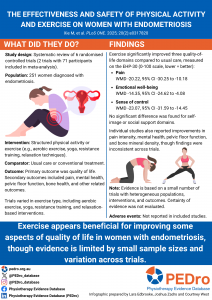
This systematic review aimed to estimate the safety and effects of physical activity and exercise compared to usual care or conventional treatment on quality of life, pain, mental health and related outcomes in women with endometriosis, a chronic inflammatory condition associated with pelvic pain and reduced quality of life.
Methods
A literature search was conducted across PubMed, Medline, Embase, Cochrane Library, and Web of Science databases from inception to May 2024. Only randomized controlled trials (RCTs) were included. Eligible studies involved women diagnosed with endometriosis and compared any structured physical activity or exercise intervention (e.g., aerobic exercise, yoga, resistance training, or relaxation techniques) with usual care or conventional treatment. The primary outcome was quality of life. Data were synthesized using Review Manager 5.4, with pooled effects expressed as weighted mean differences (WMDs) and 95% confidence intervals (CIs). Heterogeneity was assessed using the I² statistic, and fixed-effects models were applied when appropriate. Risk of bias was evaluated using the Cochrane Risk of Bias tool. Certainty of evidence was not evaluated.
Results – included trials
Six RCTs involving a total of 251 participants were included. Studies were conducted across several countries including Spain, Brazil, Australia, Sweden, China, and the United States. Sample sizes ranged from 19 to 100 participants, and interventions varied considerably in type, intensity, and duration (48 hours to 12 months). Interventions included aerobic exercise, yoga, stretching, lumbopelvic stabilisation exercises, progressive muscle relaxation, and telehealth or virtual reality-delivered programs. Only two RCTs (n = 71 participants) were sufficiently homogeneous in outcome reporting to be included in the meta-analysis. Overall methodological quality was variable, with the most common limitations including incomplete outcome reporting and lack of blinding.
Results – outcome
Meta-analysis of two trials (n = 71) demonstrated significant improvements in multiple domains of quality of life, measured using the Endometriosis Health Profile-30 (on a 0-100 scale). Specifically, significant reductions (indicating improvement) were observed in the pain domain (WMD -20.22; 95% CI -30.25 to -10.18; p < 0.0001; I² = 0%, n=64), the control and powerlessness domain (WMD -23.07; 95% CI -31.59 to -14.45; p < 0.00001; I² = 0%, n=63), and the emotional well-being domain (WMD -14.35; 95% CI -24.62 to -4.08; p = 0.006; I² = 9%, n=63). There were no statistically significant effects for self-image (p = 0.09) or social support (p = 0.17) domains. Individual studies reported improvements in pain intensity (e.g., lower visual analogue scale scores in yoga interventions), mental health (p < 0.001 in one trial), and pelvic floor muscle function and bone mineral density. However, findings for pain were inconsistent across studies, with some trials showing no statistically significant between-group differences.
Adverse events were not reported.
Conclusion
Physical activity and exercise appear to confer significant benefits for women with endometriosis, particularly in improving quality of life across key domains such as pain, emotional well-being, and perceived control. There was some evidence of benefits for pain, mental health, pelvic floor muscle function, and bone health. However, the strength of evidence is limited by small sample sizes, heterogeneity in interventions and outcome measures, and methodological limitations. Further high-quality, adequately powered RCTs with standardised outcomes and longer follow-up are required to strengthen clinical recommendations.
Xie M, Qing X, Huang H, Zhang L, Tu Q, Guo H, Zhang J. The effectiveness and safety of physical activity and exercise on women with endometriosis: A systematic review and meta-analysis. PLoS ONE. 2025;20(2):e0317820.