Approximately 55-75% of people experience reduced upper limb function following stroke.
Modified Constraint Induced Movement Therapy (mCIMT) involves using the affected limb intensively over multiple weeks, while restricting the use of the non-affected limb. Intensive, repetitive, task-specific training is performed with the affected limb only. mCIMT is different from CIMT as it follows less rigid protocols and allows for the optimisation of time and training intensity. It is frequently used instead of, or combined with, conventional therapy
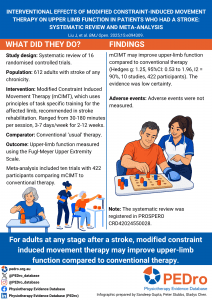
This systematic review aimed to estimate the effects of mCIMT compared to conventional therapy on upper-limb function in people with stroke of any chronicity.
Five databases were searched on 23 May 2024 for randomised controlled trials (RCTs) published in English and Chinese. Eligible studies included adults (18 years+) with a stroke of any type and any chronicity. The intervention was mCIMT and the control was conventional therapy.
The primary outcome was function, measured using the Fugl-Meyer Upper Extremity Assessment. Study selection and assessment of risk of bias, using the Cochrane Risk of Bias tool 2.0, were performed by two authors. Evidence certainty was assessed using the Grading of Recommendations, Assessment, Development, and Evaluation (GRADE) system. A meta-analysis pooled the trials, with forest plots used to summarise and compare trials. Effect estimates were quantified using Hedges g.
Sixteen trials involving 612 participants were included in the review. Overall risk of bias was low for 3 trials, some concerns for 10 trials and high for 3 trials.
Ten trials including 422 participants were included in the meta-analysis. Participants were aged from 39 to 94 and had acute stroke (2 trials), chronic stroke (5 trials) or unclear chronicity (3 trials). Interventions ranged from 30-180 minutes, 3-7 days/week for 2-12 weeks.
There was low certainty evidence that mCIMT may improve upper limb function compared to conventional therapy (Hedges g: 1.25, 95% CI: 0.53 to 1.96, n: 422, 10 trials, I2 = 90%). Subgroup analyses for stroke type, duration of disease, time of intervention, and intervention duration were performed but tests for differences between subgroups were not reported.
Following stroke, mCIMT may improve upper-limb function compared to conventional therapy. This provides evidence that mCIMT, could be used following stroke.
Liu J, Wang Z, Wang C, Zhang Y. Interventional effects of modified constraint-induced movement therapy on upper limb function in patients who had a stroke: systematic review and meta-analysis. BMJ Open. 2025. 15: e094309. doi: 10.1136/bmjopen-2024-094309 1