Introduction
This systematic review aimed to estimate the effects of app-based interventions compared to usual care or no intervention on pain, physical function, quality of life, safety, and cost-effectiveness in people with osteoarthritis.
Osteoarthritis affects approximately 528 million people globally. It is the most common degenerative joint disease, occurring most often in the knee, hip, and hand. It causes substantial pain and disability, reduces health-related quality of life and carries a high economic burden. App-based (mHealth) interventions are increasingly used to support exercise, education and self-management for people with osteoarthritis, but evidence about their safety and clinical and economic benefits has been limited.
Methods
Electronic databases (PubMed, Web of Science, Embase and the Cochrane Library) were searched from inception to 19 September 2024 for randomised controlled trials of app-based interventions in adults with osteoarthritis. The primary outcome was change in pain intensity from before to after treatment. Risk of bias was assessed using the revised Cochrane Risk of Bias tool (RoB 2.0). Random-effects meta-analyses were used to pool standardised mean differences (SMDs) and odds ratios (ORs), with 95% confidence intervals (CIs), where heterogeneity (I²) exceeded 50%.
Results – included trials
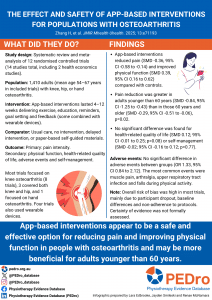
Fourteen studies (12 randomised controlled trials and 2 health economics studies), published between 2017 and 2024, were included, involving 1,410 participants (mean age 54–67 years in included trials). Eight studies focused on knee osteoarthritis, three included both knee and hip osteoarthritis, and one focused on hand osteoarthritis. App-based interventions lasted 4 to 12 weeks and typically included exercise, education, reminders, goal setting and feedback; four studies also used wearable devices. Overall risk of bias was high in 6 studies, with some concerns in 2 and low risk in 4. Risk of bias was mainly due to participant dropout, baseline differences between groups and non-adherence to published protocols.
Results – outcome
Compared with controls, app-based interventions significantly reduced pain (SMD -0.36, 95% CI -0.58 to -0.14, p<0.001, I2=72%, 12 studies) and improved physical function (SMD 0.39, 95% CI 0.16 to 0.62, p<0.001, I2=67%, 10 studies) but showed no significant benefit for health-related quality of life (p=0.08) or self-management (p=0.77). There was no significant difference in adverse events between groups (OR 1.33, 95% CI 0.84 to 2.12, p=0.23, I2=7%, 6 studies); the most commonly reported events were muscle pain, arthralgia, upper respiratory tract infection and falls during physical activity. Subgroup analysis showed greater pain reduction in adults younger than 60 years (SMD -0.84, 95% CI -1.25 to -0.43) than in those 60 years and older (SMD -0.29, 95% CI -0.51 to -0.06), p=0.02. Where cost data were reported, app-based interventions were associated with lower costs than usual care. Satisfaction and usability were high, with all reported System Usability Scale scores above 70 (considered acceptable).
Conclusion
App-based interventions appear to be a safe and effective way to reduce pain and improve physical function in people with osteoarthritis and may offer a cost-effective option, particularly in resource-limited settings. Age appears to be an important factor in treatment response, with younger adults showing greater benefit. However, the overall risk of bias was high across included trials and further well-designed studies are needed, particularly to confirm the cost-effectiveness and safety of these interventions and their benefits in older adults.
Zhang H, Wang H, Zhang C, Zhao R, Lv Q, Zhang L, Zhang H, Yan S. The Effect and Safety of App-Based Interventions for Populations With Osteoarthritis: Systematic Review and Meta-Analysis of Randomized Controlled Trials. JMIR Mhealth Uhealth. 2025;13:e71193.