Acute ankle sprains are common injuries in sports and other recreational activities. A majority of sprains are grade I (mild stretching without macroscopic ligament tear) or grade II (partial ligament tear without complete rupture).
This systematic review aimed to estimate the effects of physiotherapy compared to conventional treatment on pain intensity in people with grade I or II acute ankle sprains.
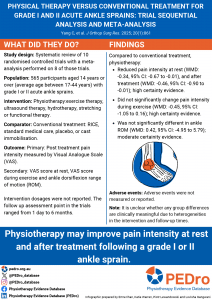
Three electronic databases, trial registries, and grey literature were searched on 21 February 2025 for randomised controlled trials (RCTs) published in English. Eligible studies sampled individuals 14 years of age and older with grade I or II acute ankle sprains. The intervention was any physiotherapy management (e.g., exercise, use of electrophysiological agents, etc). The comparator was conventional treatment including RICE (rest, ice, compression, elevation), standard medical care, placebo, or cast immobilisation.
The primary outcome was pain intensity following treatment, measured using visual analogue scale. Study selection, assessment of risk of bias, and data extraction were performed by two authors. Risk of bias domains included random sequence generation, allocation concealment, blinding of participants and personnel, blinding of outcome assessment, incomplete outcome data, selective reporting, and other bias. Evidence certainty was assessed using the Grading of Recommendations, Assessment, Development, and Evaluation (GRADE) system. A meta-analysis pooled the trials, with forest plots used to summarise and compare trials. Effect estimates were quantified using weighted mean difference (WMD) for pain intensity. Subgroup analyses were conducted for pain intensity at rest and during exercise, and dorsiflexion range of motion.
Ten trials involving 565 participants were included in the review. Overall risk of bias was low for 3 trials, some concerns for 10 trials and high for 3 trials.
Eight trials involving 519 participants were included in the meta-analysis of the primary outcome.
Average participant ages ranged between 17 to 44 years of age. Physiotherapy interventions included exercise, ultrasound therapy, thermotherapy, hydrotherapy, stretching, and functional therapy. Comparators included RICE, standard medical care, placebo, and cast immobilisation. The duration of follow-up ranged from 1 day to 6 months. Sources of risk of bias included: lack of blinding of therapist and participant (10 trials) and lack of assessor blinding (8 trials).
There was high certainty evidence that physiotherapy may improve pain intensity after treatment compared to conventional treatment (WMD: -0.46, 95% CI: -0.90 to -0.01, I2: 79%, n: 422, 8 trials). Subgroup analyses were conducted for pain intensity at rest (WMD: -0.34, 95% CI: -0.67 to -0.01, I2: 33%, n: 179, 3 trials, high certainty evidence), pain intensity during exercise (WMD: -0.45, 95% CI: -1.05 to 0.16, I2: 0%, n: 179, 3 trials, high certainty evidence), and dorsiflexion range of motion (WMD: 0.42, 95% CI: -4.95 to 5.79, I2: 88%, n: 212, 4 trials, moderate certainty evidence).
Pain intensity may improve after physiotherapy intervention overall and at rest following grade I or II ankle sprains. There were no between-group differences in pain intensity during exercise or dorsiflexion range of motion following any intervention. It is unclear whether any group differences are clinically meaningful. Limitations include heterogenous interventions and highly variable follow-up at assessment.
Yang C, Gao W, Jia Z, Li J, Tang M. Physical therapy versus conventional treatment for grade I and II acute ankle sprains: trial sequential analysis and meta-analysis. J Orthop Surg Res. 2025;20(1):861. doi:10.1186/s13018-025-06272-3