
Recovery of walking in people following stroke is often the main goal for patients, which is primarily achieved with forward walking training. It is hypothesised that the use of backward walking training may better improve the kinematic parameters of walking compared to forward walking; however, no review has explored the effect of backward walking compared to forward walking. This systematic review aimed to estimate the effects of backward walking training compared to forward walking training on walking in people after stroke.
Eight databases including PEDro, EMBASE, Medline, Scielo, AMED, Cochrane Central Register of Systematic Reviews, Cochrane Central Register of Controlled Trials, and LILACS were searched for randomised controlled trials (RCTs). Reference lists of relevant articles were also searched. No date or language restrictions were applied to the search. RCTs were eligible if participants were adults following acute stroke (≤6 months) or chronic stroke (>6 months); intervention included backward walking training, either alone or in combination with forward walking training; and the comparator was forward walking training only. Outcome measures included walking speed (metres/sec), cadence (steps/min), and stride length (metres), which is typically calculated using a timed walk test e.g., 10 m walk test, or a 3D movement analysis system. Titles and abstracts were screened for eligibility by one reviewer. Two reviewers independently screened full texts for eligibility, with disagreements resolved by a third reviewer. Data extraction of included studies was completed by two reviewers, with details of unavailable information sought from corresponding authors. Two reviewers independently evaluated the risk of bias using the PEDro scale. The overall evidence quality and strength of recommendations for outcomes was assessed using the Grading of Recommendations, Assessment, Development and Evaluation (GRADE) system. A random effects meta-analysis was conducted.
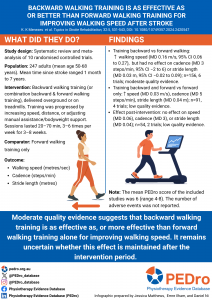
Ten studies involving 247 participants were included. The mean age of participants ranged from 50 to 68 years, and the mean time since stroke ranged from 1 month to 7 years. The mean baseline walking speed ranged from 0.2 to 1.0 m/s. Studies investigated the effect of backward walking training only (n = 3) or backward walking combined with forward walking training delivered overground or on treadmills (n = 7). Training progression was achieved by increasing speed, distance, or modifying manual assistance and bodyweight support with increasing speed or distance. Training sessions lasted 20-70 mins, 3-6 times per week for 3-8 weeks.
Meta-analysis demonstrated that backward walking training compared to forward walking training improved walking speed (MD = 0.16 m/s, 95% CI 0.06 to 0.27, n = 156, 6 trials, I2 = 0%, moderate quality evidence), but showed no effect on cadence (MD = 3 steps/min, 95% CI −2 to 6, n = 156, 6 trials, I2 = 0%) or stride length (MD 0.03 m, 95% CI −0.02 to 0.09, n = 156, 6 trials, I2 = 0%). When compared to forward walking only, backward walking training combined with forward walking training improved walking speed (MD = 0.03 m/s, 95% CI 0.01 to 0.04, n = 91, 4 trials, I2 = 7%, low quality evidence), cadence (MD = 5 steps/min, 95% CI 1 to 10, I2 = 4%, n = 75, 3 trials, low quality evidence), and stride length (MD = 0.04 meters, 95% CI −0.01 to 0.09, I2 = 5%, n = 75, 3 trials, low quality evidence). Beyond the intervention period, there was no effect of backward walking compared to forward walking on walking speed (MD = 0.06, 95% CI -0.11 to 0.22, n = 54, 2 trials, I2 = 0%, low quality evidence), cadence (MD = 3, 95% CI -2 to 8, n = 54, 2 trials, I2 = 0%, low quality evidence), and stride length (MD = 0.04, 95% CI -0.01 to 0.16, n = 54, 2 trials, I2 = 0%, low quality). The mean PEDro score of the included studies was 6 (range 4-8). The number of adverse events was not reported.
Moderate quality evidence supports backward walking training as being as or more effective for improving walking speed than forward walking training only; however, the maintenance of this effect beyond the intervention period remains uncertain.
Menezes KK, Avelino PR, Ada L, Nascimento LR. Backward walking training is as effective as or better than forward walking training for improving walking speed after stroke: a systematic review with meta-analysis. Top Stroke Rehabil. 2025;32(5):531-543. doi:10.1080/10749357.2024.2420547