Cerebral palsy (CP) is a common childhood disability characterised by motor impairments that affect mobility and functional skills. Rehabilitation programs aim to improve fitness, mobility, and participation through interventions such as fitness, strength and mobility training and task-specific exercises. Aquatic-based exercises, which utilise water’s buoyancy and thermal effects, may reduce joint stress, promote trunk control and muscle activation and enhance motivation. Previous systematic reviews have evaluated aquatic therapy benefits but have not compared aquatic- and land-based exercise effects on gross motor function in this population. The aim of this systematic review and meta-analysis was to compare the effects of aquatic-based versus land-based exercises on gross motor function in children and adolescents with CP.
The review followed PRISMA guidelines and was prospectively registered on PROSPERO (CRD42020194121). Searches across eight databases (PubMed, Cochrane Library, Scopus, Web of Science, EMBASE, SciELO Citation Index, LILACS and CINAHL), citation tracking and clinical trial registries of randomised controlled trials (RCTs) involving children aged 2–18 years with CP. Eligible interventions were structured aquatic-based exercises compared with land-based programs. Outcomes were measured using standardised tools such as the Gross Motor Function Measure (GMFM). Data extraction was performed independently by three reviewers. Risk of bias was assessed using the PEDro scale, and evidence quality was rated using GRADE. Meta-analyses were conducted using fixed-effects models. Effect sizes were reported standardized mean differences (SMD) with 95% confidence intervals. Subgroup analyses evaluated the effects of different aquatic exercise types (aquatic physical therapy, Halliwick method, swimming exercises, gait training and water exercises).
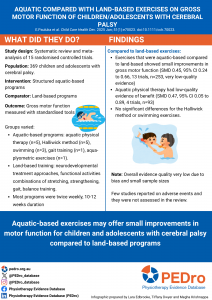
Fifteen RCTs published between 2007 and 2023 were included, involving 369 participants aged 2–18 years. Most participants were ambulatory and classified as Gross Motor Function Classification System levels I–III with spastic hemiparetic or diparetic CP. Interventions varied: five studies used aquatic physical therapy, five applied the Halliwick method, three focused on swimming, one on gait training in water, and one on aqua-plyometric exercises. Land-based programs included neurodevelopmental treatment approaches, functional activities and combinations of stretching, strengthening, gait and balance training. Most interventions lasted 10–12 weeks, with session durations 30–60 minutes, twice weekly. Risk of bias was high overall, frequently due to lack of concealed allocation, incomplete follow-up and lack of intention-to-treat analysis; only six studies were rated as good quality.
Meta-analysis of 13 trials (n=253) showed very low-quality evidence that aquatic-based exercises improved gross motor function compared to land-based exercises (SMD 0.45, 95% CI 0.24 to 0.66, p<0.001), indicating a small effect size. Subgroup analysis revealed low quality evidence of benefit for aquatic physical therapy (SMD 0.47, 95% CI 0.05 to 0.89, 4 trials, n=93, p=0.03). No significant differences for Halliwick method (SMD 0.33, 95% CI -0.01 to0.67, 4 trials, n=138, p=0.06, low quality evidence) or swimming exercises (SMD 0.47, 95% CI -0.09 to 1.03, 3 trials, n=52, p=0.10). Overall, heterogeneity was low (I²=0 to 5%), but methodological limitations and small sample sizes reduced confidence in findings. Few studies reported on adverse events and they were not assessed in the review.
Aquatic-based exercises, particularly aquatic physical therapy, may offer small improvements in gross motor function compared to land-based programs for children and adolescents with CP. However, evidence quality was low due to high risk of bias, small sample sizes, and intervention heterogeneity. Aquatic therapy could serve as an adjunct or alternative to land-based therapy, but decisions should consider accessibility, cost, and patient preference. Future research should involve well-designed trials with adequate sample sizes and standardised protocols.
Pauluka E, Ceolin LS, Fontanela LC, Dos Santos AN. Aquatic Compared With Land-Based Exercises on Gross Motor Function of Children/Adolescents With Cerebral Palsy: A Systematic Review With Meta-Analysis. Child Care Health Dev. 2025 Jan;51(1):e70023. doi: 10.1111/cch.70023.